
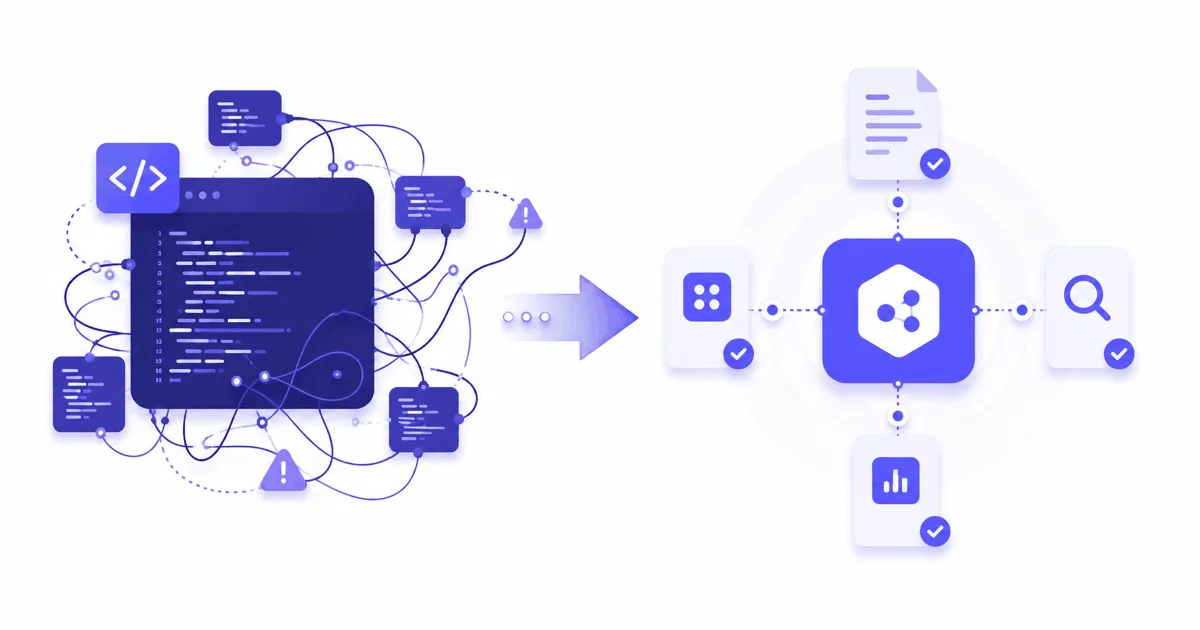
Botpress works well for engineering teams building custom conversation flows with full control over logic and integrations. For most enterprise use cases, however, the maintenance overhead, DevOps requirements, and lack of native document ingestion make it a poor fit. This guide covers what enterprises actually need from a Botpress alternative and where no-code RAG platforms draw the line.
Why enterprises look for Botpress alternatives in 2026
Botpress requires ongoing developer involvement: writing flows, managing NLU training, debugging API connections, and maintaining self-hosted infrastructure. Most enterprises need none of this.
Botpress is one of the most capable open-source chatbot frameworks available. It gives developers fine-grained control over conversation design, intent recognition, and channel integration. That power has a cost: the platform is built for developers, not for the HR manager who wants to deploy an intranet FAQ bot, or the IT team that needs to automate L1 helpdesk tickets without a six-month development project.
The most common reasons enterprises search for Botpress alternatives:
- No native document ingestion: Botpress does not connect to SharePoint, Confluence, or PDFs out of the box. Indexing enterprise documents requires custom code.
- Flow-based architecture ages quickly: scripted conversation trees require continuous maintenance as products, processes, and policies change. RAG architectures answer from live documents and self-update when sources change.
- Self-hosting complexity: running Botpress in production requires container orchestration, database management, and infrastructure monitoring. Small IT teams absorb this cost invisibly.
- No non-technical ownership: once developers build the bot, any content change requires a developer. Business stakeholders cannot manage the system independently.
According to the Botpress GitHub repository, the platform has over 14,000 stars and an active developer community. It is a strong choice for engineering teams. For teams without dedicated bot developers, the fit is weaker.
Botpress vs RAG platform: what changes operationally
A RAG platform eliminates the flow-building step entirely. Instead of scripting answers, you connect your existing documents. The AI generates answers from your content at query time.
The operational difference between Botpress and a no-code RAG platform is fundamental, not cosmetic.
| Dimension | Botpress | No-code RAG platform |
|---|---|---|
| Setup | Build conversation flows in the IDE | Connect document sources (SharePoint, PDFs, Confluence) |
| Content update | Edit flows in the UI or code | Update the source document; the bot reflects changes at next sync |
| Who maintains it | Developer required | Business owner or IT admin |
| Answers from | Hardcoded responses + API calls | Live document retrieval + LLM generation |
| GDPR / on-premise | Self-hosted possible but complex | On-premise option purpose-built for compliance |
| Hallucination control | Manual scripting limits scope | Citation-based retrieval limits answers to indexed sources |
The key shift is who owns the system after deployment. With Botpress, developers own it. With a no-code RAG platform, the business team owns it.
When Botpress remains the right choice
Botpress is the right tool when you need scripted multi-step flows, complex API orchestration, or custom channel integrations that go beyond standard document Q&A.
Before recommending an alternative, it is worth being honest about what Botpress does best:
- Complex transactional flows: booking systems, form-driven processes, multi-step workflows that combine user input with API calls (CRM updates, ticket creation, calendar booking). RAG is not the right architecture for these.
- Custom NLU with narrow intent sets: if your use case has exactly 15 intents and you need precise intent routing, a scripted approach gives more control than retrieval-based generation.
- Legacy channel integrations: teams already using Botpress with custom connectors to proprietary systems have a switching cost that may not be justified.
- Full conversation logic ownership: some regulated industries require every possible bot response to be pre-approved by compliance. Flow-based architectures make this easier to audit than generative outputs.
If your use case is primarily document Q&A, knowledge retrieval, or internal support where the answers exist in your company documents, a RAG platform will outperform Botpress on every operational dimension.
What to evaluate in a Botpress alternative
The four criteria that matter for enterprise: native document connectors, on-premise or EU hosting, access control inheritance from source systems, and non-technical deployment without ongoing developer involvement.
When evaluating Botpress alternatives for enterprise deployments, focus on:
Document connectors: does the platform natively connect to SharePoint Online, Confluence Cloud, Google Drive, and PDF folders without custom code? Manual document upload does not scale.
Access control: does the chatbot inherit the permissions from your source systems? A document marked confidential in SharePoint should not be surfaced to all employees via the chatbot. Permission inheritance at the document level is a non-negotiable for HR and legal content.
Hosting model: US-based SaaS is subject to the Cloud Act regardless of where data centers are located. Enterprises handling sensitive internal documents need either an EU-hosted option with a proper DPA, or on-premise deployment where data never leaves the corporate network.
Non-technical ownership: the platform must be maintainable by the team that owns the knowledge base, not by the team that deployed it. Updates to documents should reflect in the chatbot without developer intervention.
Source citation: for internal use cases, employees trust answers more when the chatbot cites the exact document and section it retrieved from. This reduces errors and builds user confidence faster than unsourced responses.
Deploying a no-code RAG chatbot as a Botpress replacement
Connect your three most-used document sources, configure access rights, deploy the widget, and validate with 20 test questions. Total time: 30 to 60 minutes.
The deployment process for a no-code RAG platform follows five steps that require no developer:
Step 1: identify your three highest-traffic document sources. Focus on sources that generate the most repetitive questions. SharePoint HR policies, Confluence IT procedures, and a product knowledge base cover the majority of internal support volume in most enterprises.
Step 2: connect sources via the no-code interface. Enter your SharePoint site URL and credentials. The platform crawls and indexes the content automatically. Initial indexing takes minutes to hours depending on document volume.
Step 3: configure access control. Set which user groups can query which document sources. For an HR chatbot, exclude documents tagged confidential-management from general employee access. Permission rules are set once in the platform dashboard.
Step 4: deploy to your target channel. Activate the web widget (a one-line snippet for your intranet), the Microsoft Teams integration, or the Slack app. No code required for standard channels.
Step 5: validate with production questions. Run 20 questions from actual employee tickets or past support requests. Verify that answers cite the correct document and that out-of-scope questions are correctly declined.
For a technical guide to connecting SharePoint and Confluence as document sources, see how to connect SharePoint, Confluence, and PDFs to an AI agent.
Migration from Botpress: what to expect
You are not migrating bot logic: you are replacing it. Your documents become the knowledge base. Botpress flows do not need to be exported or converted.
Migrating from Botpress to a no-code RAG platform is not a technical migration in the traditional sense. There are no flows to export, no intents to retrain, no API configurations to replicate.
What you do instead:
- Audit which questions your Botpress bot currently answers. Export or document the intent library and response content.
- Identify the source documents that contain those answers. Most scripted responses were written by someone copying from a policy document or procedure guide. Those originals are your RAG sources.
- Connect those documents to the RAG platform during the 30-minute setup.
- Validate coverage: run your top 50 historical bot queries through the RAG chatbot and verify that answers are correct and cited.
- Deprecate Botpress flows progressively, starting with the highest-volume, lowest-complexity intents (FAQ, policy lookups, procedure retrieval).
For organizations using Botpress to handle customer-facing support alongside internal knowledge retrieval, a parallel deployment is common: keep Botpress for transactional flows (booking, ticket creation) and deploy a RAG chatbot for document Q&A.
No-code RAG platforms are designed to reduce deployment time to days rather than months. The 30-minute estimate covers source connection and widget activation; full production validation with user testing typically takes one to five working days depending on document volume and access control complexity.
GuardWeaver deploys as a self-hosted RAG platform (on-premise on your infrastructure) or as a SaaS hosted in the EU, with GDPR DPA, SharePoint and Confluence native connectors, and Microsoft Teams integration included. Request a demo on your own documents or view pricing.